Sprout SEO

What's new?

Stay up-to-date with Sprout SEO's enhancements to better inspire and transform your SEO workflow.

Latest Version 4.5 Bug fixes New features

July 14, 2026

4.5 — AI Insights at Scale

What’s new

AI Search Insights — see how ChatGPT actually searches

Capture, analyze, and export every AI search conversation: query fan-outs, cited sources, products, entities, and the signals ChatGPT sends behind the answer — not just the finished text.

Following the research by Suganthan Mohanadasan, we’ve extended AI Search Insights to surface three sourcing signals that live in ChatGPT’s network traffic but never appear in the reply itself. Together with deeper fan-out typing, carousels, and merchant data, you can reconstruct how the model searched and which infrastructure fetched the sources your content competes against.

Turn intent

We now capture the server-side turn_use_case field — the intent category ChatGPT assigns to each turn (e.g. shopping, web search). It shows how the model framed the request before answering: a sharp signal for spotting when a query triggers commercial vs. informational behavior. Displayed as an Intent badge on the open conversation, captured live from the response stream.
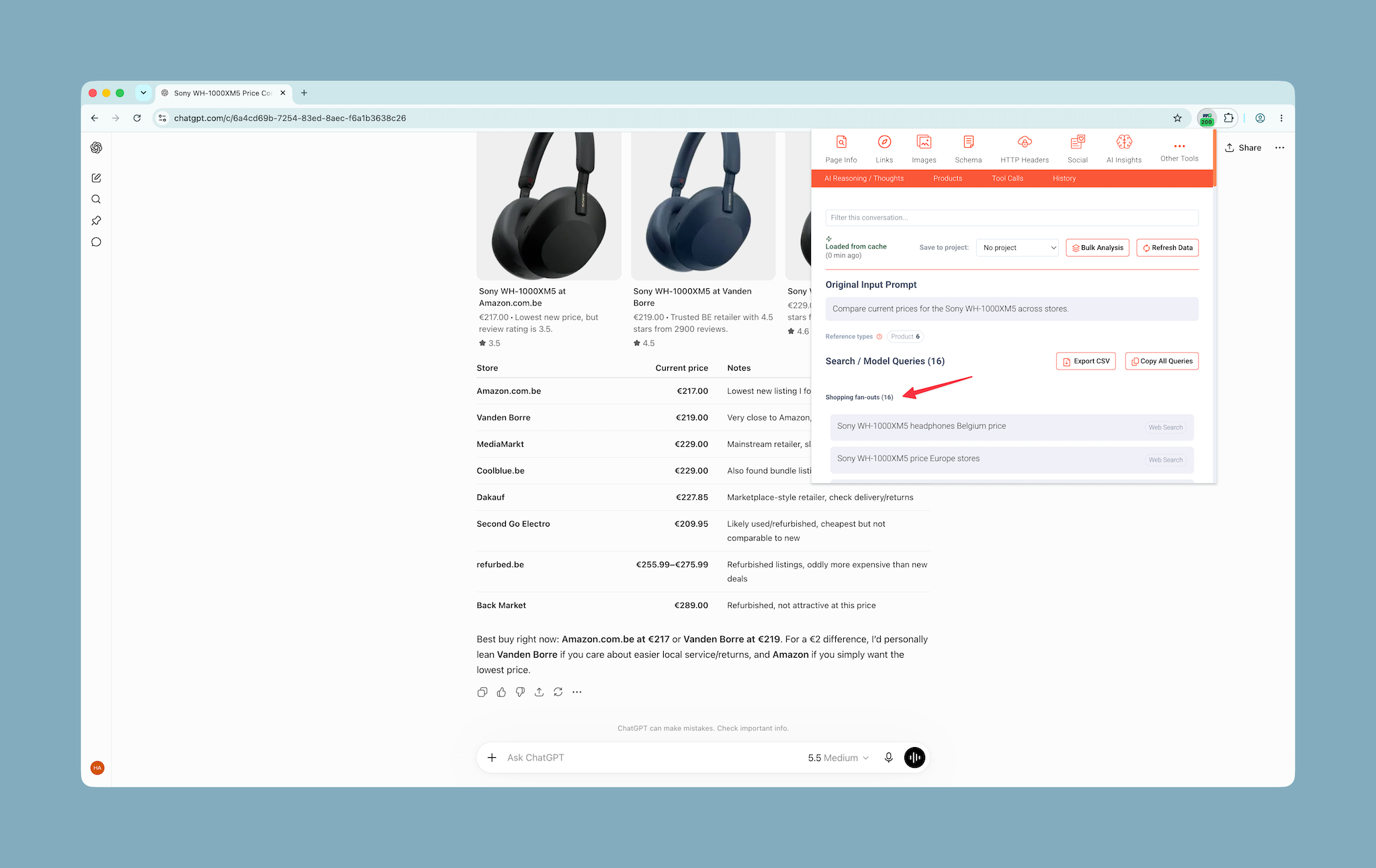
capturing the intent category in ChatGPT
(more…)

Version 4.4.7 Bug fixes

July 3, 2026

4.4.7 – AI overviews back in view

Bug fixes

  • Fixed: AI Overviews stopped being detected. Google moved AI Overviews out of the #rso results container into a new #Odp5De block that renders above the organic results, so the extension reported “No AI Overview found” on every SERP that had one. The extractor now looks in the new location (and watches for overviews that render a beat late), so AI Overview capture works again — verified live on both English and Dutch SERPs.
  • Fixed: Tab hang / crash on schema-heavy pages. On pages with lots of microdata (think large product grids), the schema scanner could balloon into millions of calls, freezing the main thread and leaving the popup stuck on “Loading…”. The scan is now linear and guaranteed to finish, so those pages load instantly. Thanks to Peter Visser for reporting this.
  • Fixed: Schema tab collapsed repeated properties. Microdata that repeats a property — a BreadcrumbList, an ItemList — was being flattened into a single value or a run-on string (e.g. “Home Aanbiedingen Outlet …”). Repeated properties are now shown as proper arrays, so breadcrumbs and item lists display each entry correctly.
  • Fixed: HTTP Headers tab now shows a distinct loading state versus an error state, instead of making a slow fetch look like a failure.
  • Fixed: A false “AI Overview” match. Featured Snippets and People Also Ask blocks that reuse the same layout class as AI Overviews are no longer mistaken for an overview.
  • Fixed: A robots.txt fetch that fails (network error or timeout) is now reported as unavailable rather than being treated as an empty file — which previously mislabeled the URL as crawl-allowed.
  • Fixed: A malformed or older history entry could crash the whole AI Search view on open. The popup now renders safely even when stored data isn’t in the expected shape.

(more…)

Version 4.4.6 Bug fixes

June 17, 2026

4.4.6 – Crawl by the Rules

Bug fixes

  • Fixed: The robots.txt checker could report a URL as ALLOWED while Google Search Console showed it blocked by robots.txt. The parser now follows how Google actually reads robots.txt (RFC 9309): consecutive User-agent lines grouped with only ignored directives between them (like Crawl-delay) stay in one group, so a trailing Disallow applies to the right crawler — including *. Thanks to Kevin Vandeplassche for flagging this on LinkedIn.
  • Fixed: Rules that target query strings (e.g. Disallow: /*?, /*sid=, /*.php?) were never matched because we only checked the path. Matching now includes the query string, same as Google.
  • Fixed: Wildcard patterns (* and $) and longest-match precedence were not applied correctly. Conflicting Allow and Disallow rules now resolve the way Google documents: longest match wins; on a tie, Allow beats Disallow.
  • Fixed: Googlebot-specific groups were ignored when a generic * group existed. A dedicated Googlebot block can now override *, and an empty Googlebot group (crawl-delay only) correctly means crawlable even when * disallows everything.
  • Fixed: A missing robots.txt (HTTP 404) was shown as “NOT FOUND” instead of treated as no restrictions. 404 and other 4xx responses (except 429) now correctly mean crawling is allowed; 429 and 5xx show an unavailable warning, matching Googlebot behavior.
  • Fixed: Switching tabs or URLs quickly could leave the robots.txt status showing the previous page. A race guard ensures only the latest fetch updates the UI.
  • Fixed: Network and unexpected errors were lumped together as “NOT FOUND”. CORS/DNS failures are now distinguished from server errors, and the copy-robots button no longer serves stale content from another page after an error.

(more…)

Version 4.4.5 Bug fixes

March 20, 2026

4.4.5 – Small bugfixes

Bug fixes

  • Fixed: An issue with the X-Robots-Tag detection and display that was reported by Mathias Noyez from Depends SEO agency in Belgium. Thanks for the heads-up—we’ve corrected how the extension reads and surfaces the X-Robots-Tag HTTP header so it now reflects the actual indexability status as intended.

What’s new

  • We’ve added an AI Robots Tag checker so you can see at a glance how the X-Robots-Tag (and related directives) affect indexing for the page you’re on. It sits alongside the existing meta robots and X-Robots status in the extension, giving you a clearer picture of how crawlers and AI systems are being instructed to treat the page.

January 28, 2026

4.4 — The AI Whisperer

What’s new

AI Insights

We’ve added a brand new AI Search Insights tab that reveals the hidden search queries that ChatGPT and Gemini generate when they’re answering your questions. Ever wondered what queries an AI chatbot uses when it searches the web for you?

Now you can see exactly what’s happening behind the curtain. The extension automatically extracts query fan-outs from both ChatGPT and Gemini, giving you unique insights into how AI models interpret questions and search for information.

(more…)

January 18, 2026

4.3 – The Inspector

Note on permissions, why the scary permissions prompt? Don’t worry, we’re not spying on you! The “Toggle JavaScript” feature requires Chrome’s contentSettings permission, which Chrome describes as accessing “geolocation, microphone, camera, cookies, etc.” In reality, we only use it to flip JavaScript on/off. Chrome just warns about everything this API could control, not what we actually do with it.

What’s new

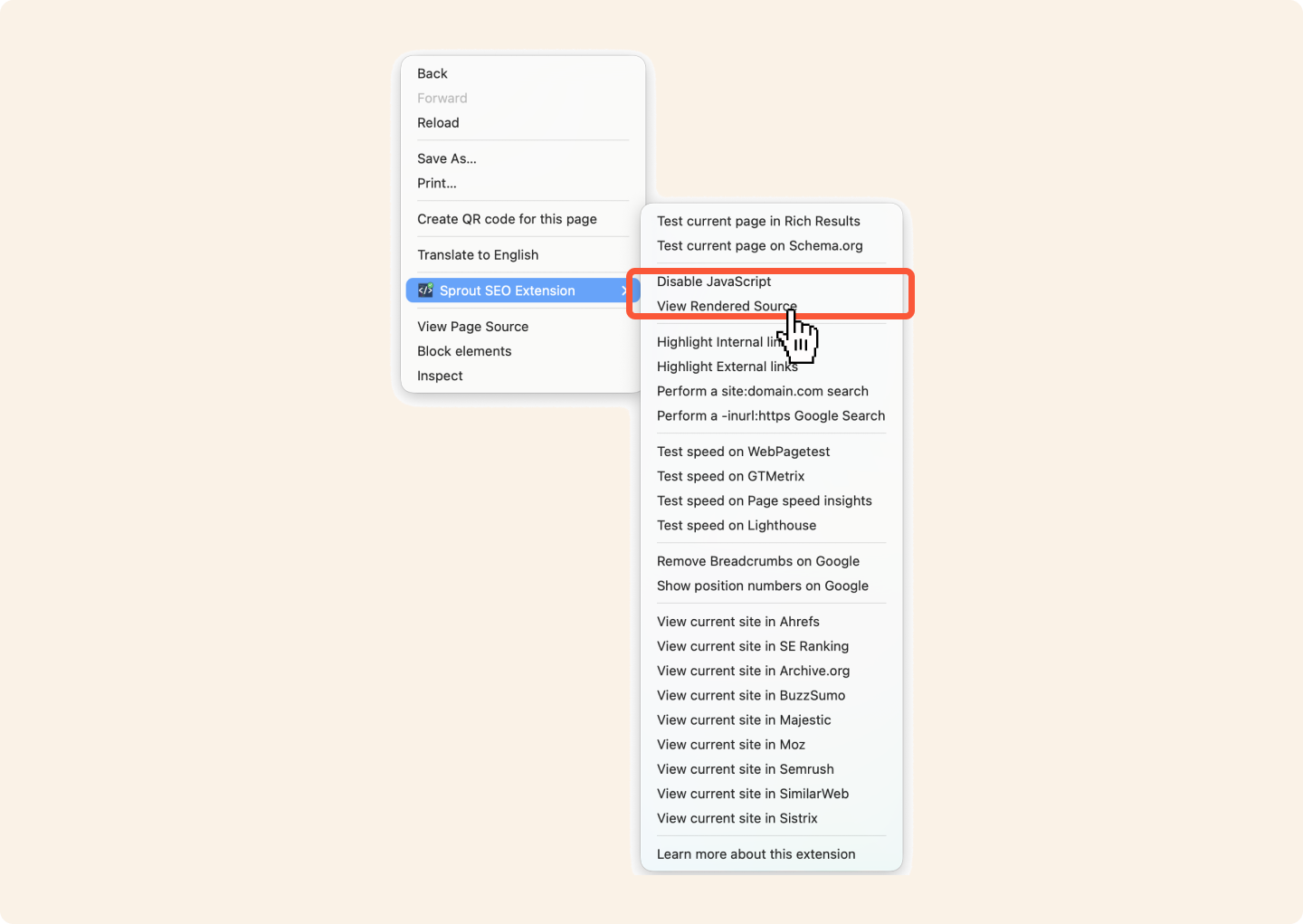
  • We’ve added two new tools to help you diagnose issues with JavaScript-heavy websites. First, you can now disable JavaScript entirely, because sometimes the best way to see what’s really happening is to see what happens when nothing happens.Disable JavaScript and have the ability to view the rendered source straight from the right-click context menu
    (more…)
Version 4.2.4 Bug fixes

July 10, 2025

4.2.4 – small bugfixes

After a recent change in the SERP, there was an issue with the Core Web Vitals module in the SERP. This is now fixed, together with the status icons in the icon pin.