


What’s new
AI Search Insights — see how ChatGPT actually searches
Capture, analyze, and export every AI search conversation: query fan-outs, cited sources, products, entities, and the signals ChatGPT sends behind the answer — not just the finished text.
Following the research by Suganthan Mohanadasan, we’ve extended AI Search Insights to surface three sourcing signals that live in ChatGPT’s network traffic but never appear in the reply itself. Together with deeper fan-out typing, carousels, and merchant data, you can reconstruct how the model searched and which infrastructure fetched the sources your content competes against.
Turn intent
We now capture the server-side turn_use_case field — the intent category ChatGPT assigns to each turn (e.g. shopping, web search). It shows how the model framed the request before answering: a sharp signal for spotting when a query triggers commercial vs. informational behavior. Displayed as an Intent badge on the open conversation, captured live from the response stream.
Reference types
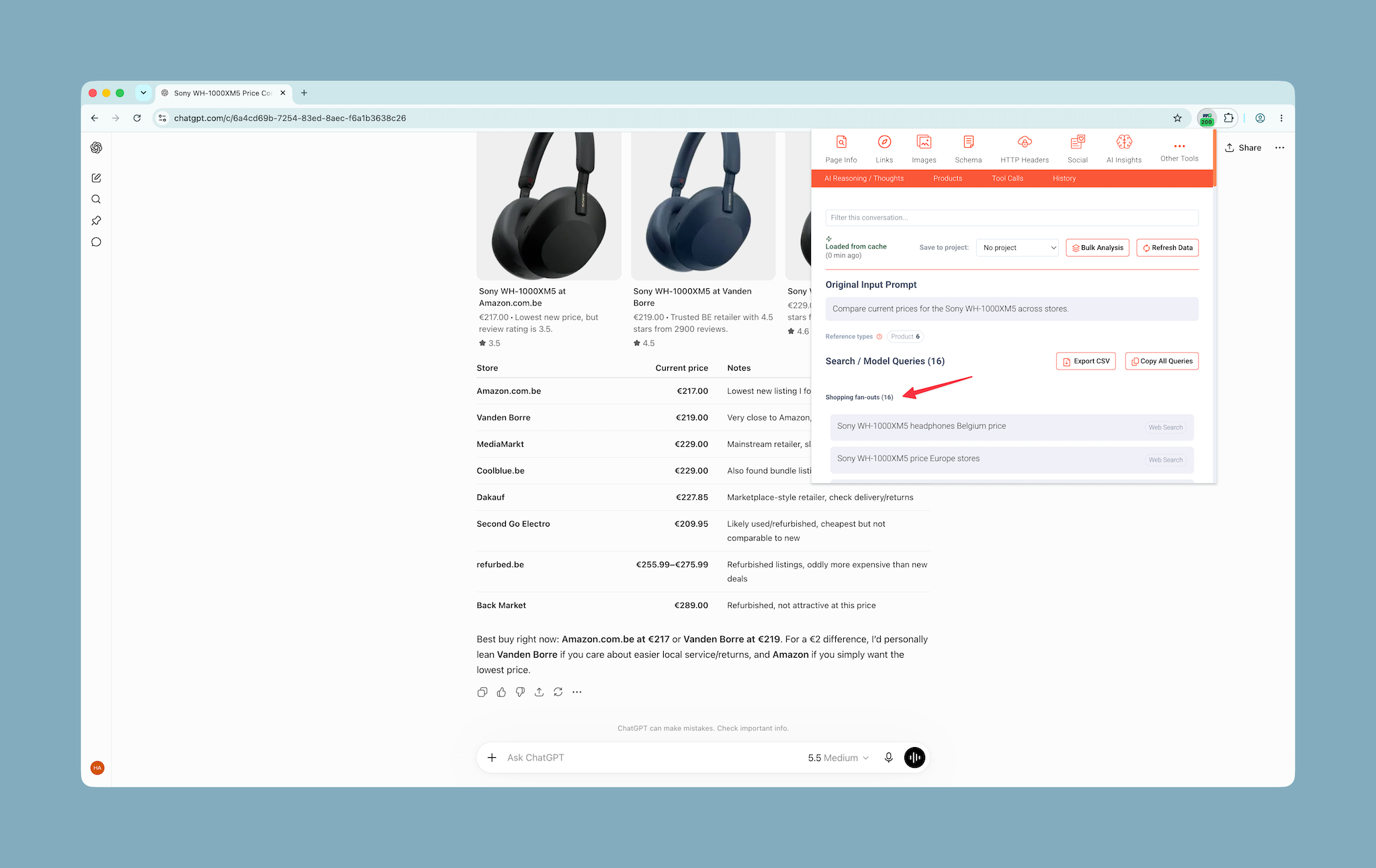
A breakdown of the inline citation markers embedded in the answer (e.g. product (9), search (3), news (1)). Parsed from the response’s reference tokens, it shows the mix of source types ChatGPT actually cited — products, web results, news, images, and more — and in what proportion. Chips with hover tooltips explain each category.
Sourcing pipelines
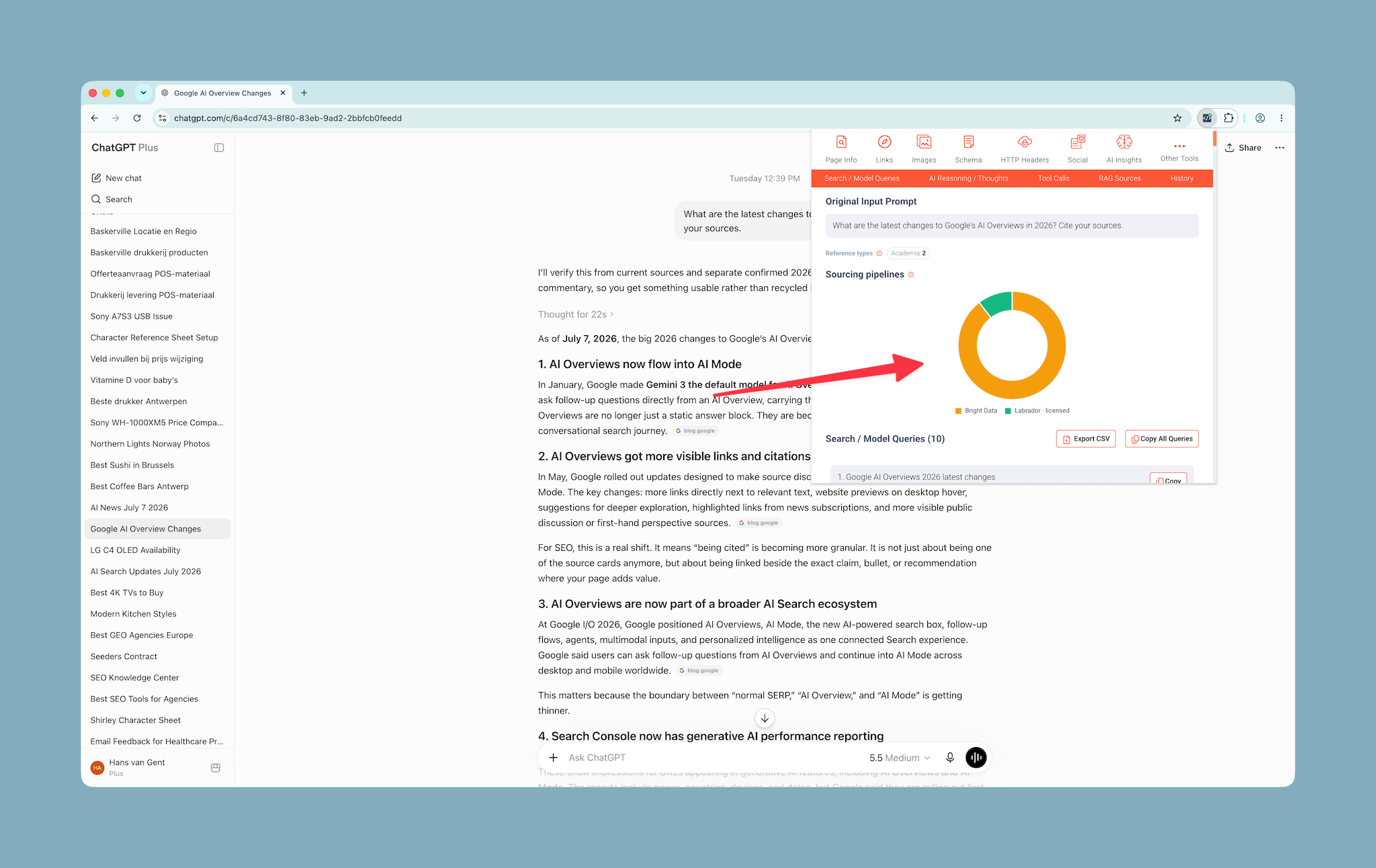
Each cited web result carries a result_source field naming the data provider that fetched it: Bright Data, Oxylabs, Licensed (Labrador), or SERP. We aggregate these per conversation (e.g. oxylabs (10), bright (6)) and chart them in the conversation view, so you can see which sourcing stack sits behind the citations.
Fan-outs, carousels & entities
- Typed fan-out queries — Search, Shopping, and Image fan-outs are distinguished (shopping queries are shorter and route differently; image fan-outs are more numerous). Opaque GPT-5.5 product tokens are decoded into readable shopping queries where possible.
- Carousels — Product, image, news, and place carousels are identified automatically. Merchant offers show as one product with prices and seller links; image grids deduplicate by actual image URL, not just the source page.
- Entity recognition — Named entities ChatGPT flags (products, places, organizations, news-related topics) are extracted and classified, giving a view into how the model understands the subject matter.
- Reasoning telemetry — Where ChatGPT exposes thinking time, effort level, titles, and stop tokens, they’re captured and surfaced in the bulk dashboard.
Richer source panel
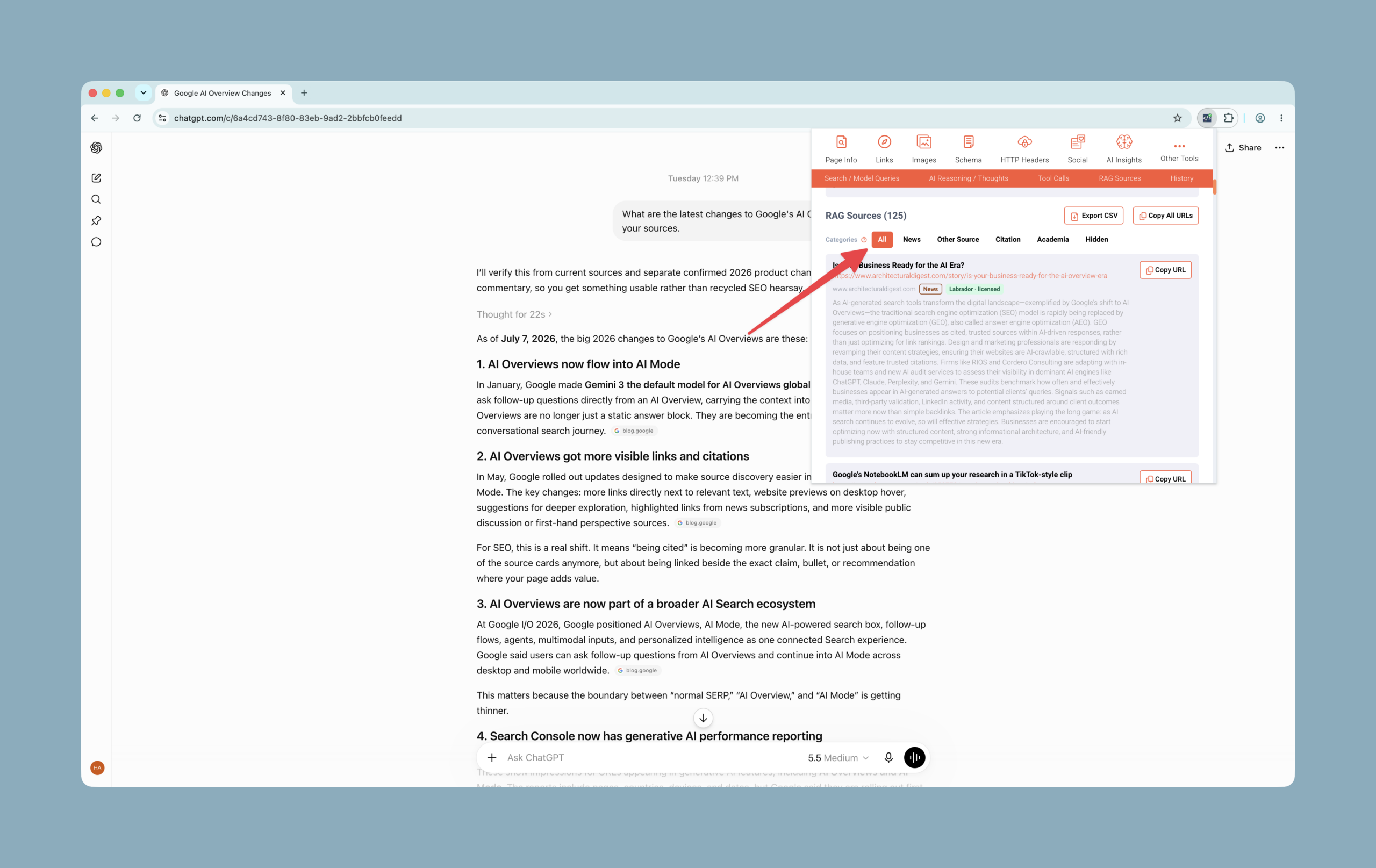
Every link is categorized as citation, other, hidden, or academia, with tooltips explaining why. Inline grouped-webpage chips count as citations. Source titles and snippets are preserved for export.
Projects
Group History conversations by client, campaign, or topic. Filter the list and stat cards by project, assign from each card or the open conversation, and manage projects inline in the popup — then analyze one client’s AI visibility without wading through everything else.
Gemini & Google AI Overview
All of the above sit alongside the existing Gemini fan-out capture and Google AI Overview extraction (queries, citations, cleaned prose). The full AI Search tab is localized across all seven locales.
Bulk ChatGPT Prompt Analysis
Queue prompts, auto-submit them to ChatGPT one by one, and automatically capture every response — then turn the batch into a cross-conversation analytics dashboard.
- Prompt loader — Paste a prompt list, start a run, watch live progress (pending/running/done/error), pause and resume, save lists for later, and open Bulk analysis from any AI Insights state.
SCREENSHOT NEEDED: bulk_prompt_analysis.html Run segment — prompt textarea, Start/Stop, live progress list. Open via “Bulk analysis” button on AI Insights. Code: bulk-run-segment in bulk_prompt_analysis.ts
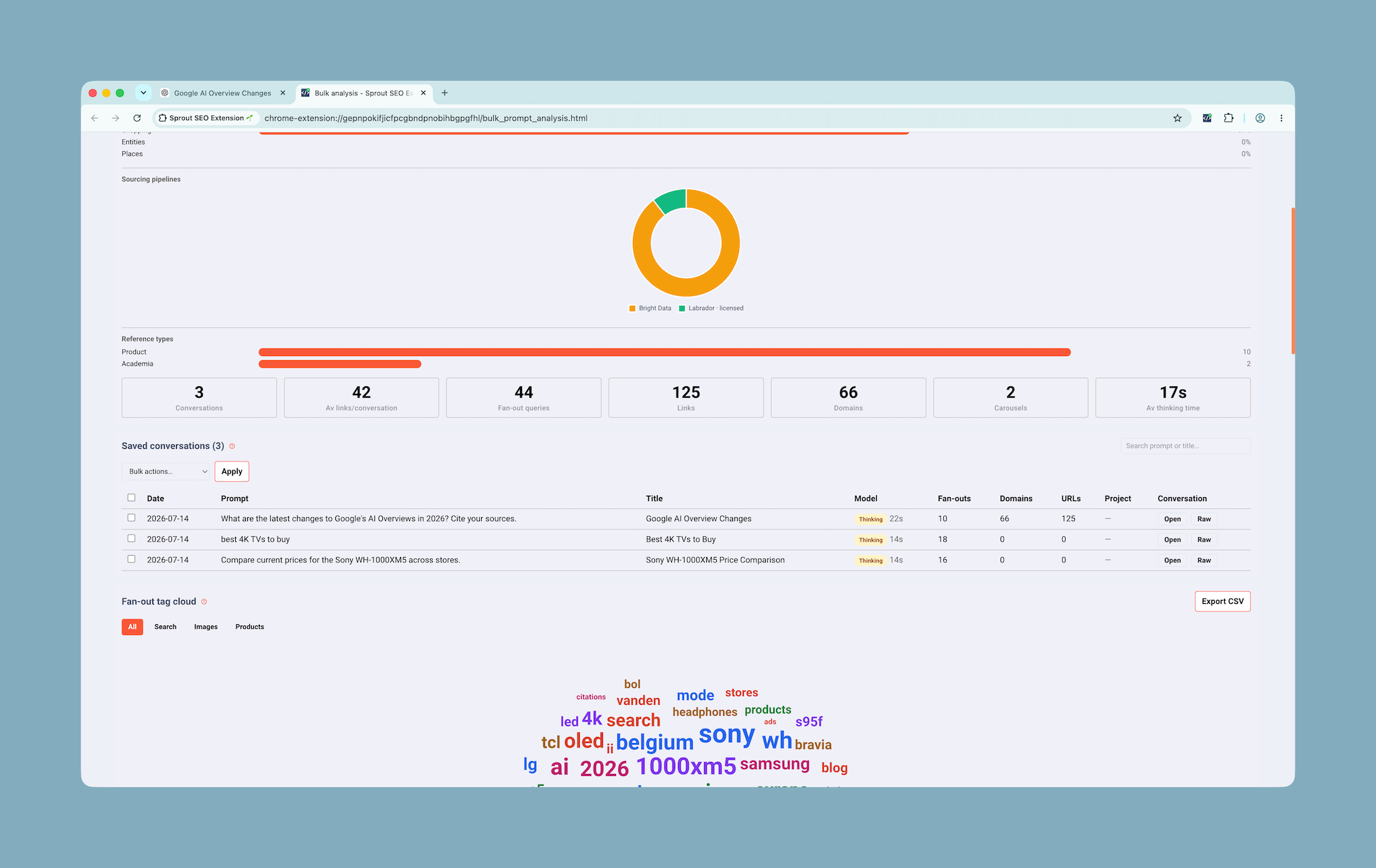
- Dashboard — Reconstruct how ChatGPT searched across the whole run:
- Top domains & top URLs with independent category filters and a Ref-style role per link
- Word cloud of fan-out terms (real 2D spiral packer, sized and coloured by frequency)
- Sourcing-pipeline doughnut and carousel-position breakdown
- Model-type badges and reasoning stats where available
- Overview tiles grouped by signal type
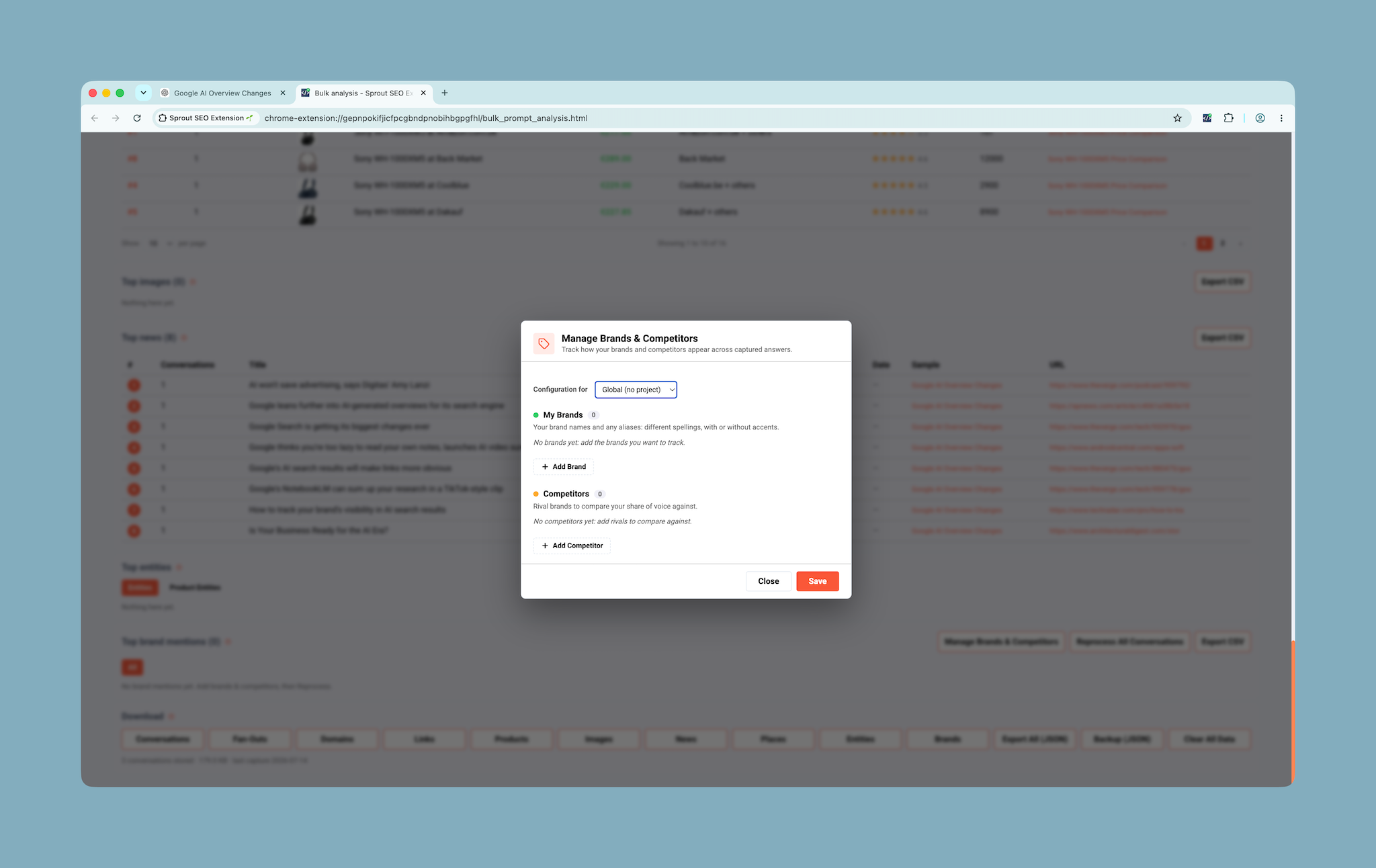
- Brands & competitors — Configure brands and aliases, track mention counts with contextual passages across every conversation in the run, reprocess after you update the list, and manage everything from a dedicated modal.
- Exports — CSV and JSON per dashboard section, fan-out tag-cloud export, plus a raw-data viewer. Per-section info tooltips replace a separate Help modal so context stays next to the data.
- Table polish — Paginate at 10 / 25 / 50 / 100 per page; quiet row actions (Open / Raw / Details); light-mode readability and on-brand controls throughout.
Bug fixes
- Fixed: Firefox AI capture was largely dead. ChatGPT Intent, merchant offers, and Gemini fan-outs never landed on Firefox MV2. A background stream capture now tees the same responses the page receives — no page injection, no CSP fights — and writes into the same storage the popup reads. Chrome is unchanged.
- Fixed: Gemini on Firefox captured nothing because the interceptor only matched a specific RPC id in the URL; that id lives in the response body. Any
batchexecuteresponse is now handled. - Fixed: Google AI Overview content sometimes included raw CSS and JavaScript from the page. Extracted prose is cleaned before display.
- Fixed: Inline citation chips from grouped webpage references were miscounted as “Other source” instead of citations.
- Fixed: Image carousel dedup collapsed distinct photos sharing the same source page. Dedup now keys on the actual image URL.
- Fixed: Merchant offers rendered as one card per merchant instead of one product with an offers list — including after cache refresh.
- Fixed: HTTP Headers tab overflow in the popup; the panel now respects popup width.
- Fixed: CSV exports could trigger spreadsheet formula injection in Excel. All exporters now escape dangerous leading characters.
Improvements
- Security hardening — Gemini relay nonce authentication, scheme-gated links in bulk analysis, atomic per-conversation storage writes. No behavior change on benign pages.
- Performance — Cache-Control header parsing is linear again (an earlier regression had made it quadratic on long header values).
- UI polish — Submenu clearance under the fixed bar, consistent button weights, dashboard card rhythm, tag-cloud stopword calibration, and a full design pass on the bulk-analysis shell.